The School of Fashion and Textiles (SFT) is proud to announce that our faculty members have secured notable General Research Fund (GRF) grants from the Research Grants Council (RGC) for the 2026/27.
Among the funded projects, three stand out for their direct drive toward Environmental, Social, and Governance (ESG) transformation — spanning sustainable textile manufacturing, circular economy solutions, and global supply chain resilience.
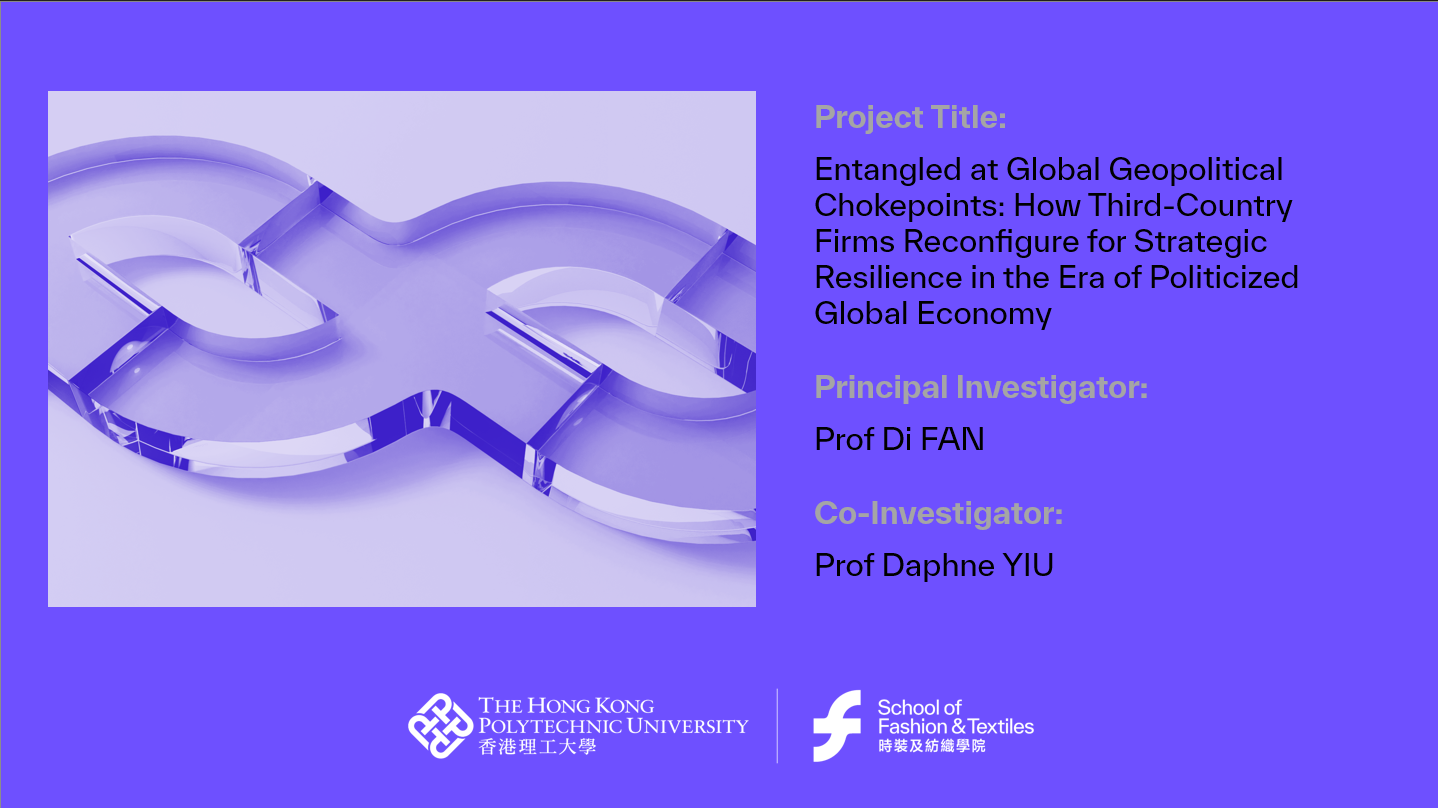
Project Title: Entangled at Global Geopolitical Chokepoints: How Third-Country Firms Reconfigure for Strategic Resilience in the Era of Politicized Global Economy
Principal Investigator: Prof Di FAN
Co-Investigator: Prof Daphne YIU
Abstract: Geopolitical tensions increasingly shape firm strategy and performance in today’s multipolar world. While much of the international business (IB) literature focuses on firms located directly in conflict zones, many firms are unavoidably exposed through their stretched global supply chains. These exposures often emerge as unexpected crises, such as terrorist attacks or sudden escalations, which ripple outward from conflict areas. Existing research often assumes that “third-country firms”—firms headquartered outside the warring parties yet materially affected through their cargo or sourcing networks—are neutral bystanders. In reality, they are frequently drawn into geopolitical dynamics, and their responses at chokepoints reveal both the risks of alignment and global value chain resilience. We investigate this issue in the context of the 2023 Red Sea crisis, an outgrowth of the Israel–Palestine conflict that escalated into Houthi militant attacks on commercial shipping. We use the hijacking of the Japanese vessel Galaxy Leader on 19 November 2023 as the exogenous onset of the crisis, when risks were visibly extended to vessels and cargos of third-country firms. We conceptualize such geopolitical disruptions at chokepoints as environmental jolts that reprice corridor conditions, such as security and insurability, and compel firms to reassess sourcing and routing. Drawing on international relations literature on alignment behavior, we theorize two parallel strategic alignment responses. The first is bandwagoning, observable in friend-shoring and friend-corridor routing. The second is balancing, observable in diversifying-shoring and diversifying-routing. We further specify two geopolitical risks that moderate these choices: entrapment risk, which captures the costs of visibly aligning with one side, and abandonment risk, which reflects the costs if expected protection support is withdrawn. Empirically, we implement a regression discontinuity difference-in-differences (RD-DiD) design. Firms with cargo transited the Red Sea–Bab al-Mandab Strait on or after 19 November 2023 are treated as exposed, while those whose cargo passed just before serve as near-miss controls. Voyage-level exposure is aggregated to the firm-quarter level to analyze post-crisis adjustments in sourcing and routing. We also examine performance outcomes of shipment punctuality and return on assets. This study makes three contributions to IB. It introduces geopolitical chokepoints as corridor-level institutions that directly shape firm behavior. It shows that third-country firms are not neutral but first-order subjects of conflict spillovers. Finally, it links strategic responses to post-crisis performance, revealing an arbitrage-type resilience mechanism where reconfiguration can mitigate disruption and sometimes improve efficiency.
Project Title : Solutions for Post-Consumer Garment Waste Management: An Investigation of Sorting Mechanism for Reuse
Principal Investigator: Prof Magnum LAM
Co-Investigator : Prof Christina WONG
Abstract: Over 92 million tonnes of textile waste are discarded in landfills annually, projected to soar to 134 million tonnes by 2030. 87% of this waste is post-consumer garments (PCGs), over 90% of which can potentially be reused. However, only 8 out of 100 discarded garments are reused. Reuse is considered the least resource-depleting solution, as it extends product lifespans, reduces waste, and decreases demand for new production. Yet the vast majority of PCGs end up in landfills or incinerators, causing significant pollution and resource waste. This underscores inefficiencies in PCG waste management and the urgent need for change. Guided by the United Nations Environment Programme (UNEP) and updates to the European Union’s Extended Producer Responsibility (EPR) framework, countries like the United States, Japan, China, and those in Europe are reforming garment waste policies to prioritize reuse, with the aim of reducing landfill disposal of PCGs. Effective sorting is critical to maximizing reuse but remains a complex, labor-intensive process due to diverse conditions, fabrics, trims, and layers of PCGs. These challenges are exacerbated by inadequate infrastructure, limited technical expertise, and low economic returns. Unlike recycling, which relies on fiber-based sorting, reuse requires multidimensional assessments of quality, wearable condition, and fashionability to determine a garment’s value and suitability for resale or donation. However, research has largely focused on recycling technologies, neglecting the development of standardized metrics and scalable sorting processes needed to optimize product reuse. This gap significantly hampers efforts to extend product lifespans and unlock the environmental benefits of reuse. This study examines solutions to improve sorting processes for increasing PCG reuse. By employing a multi-method research design—including Material Flow Analysis, PCG quality assessments, fieldwork, and in-depth interviews—the study provides a comprehensive evaluation of sorting practices for product reuse. In collaboration with five leading and international NGOs in Hong Kong (i.e., The Salvation Army, Friends of the Earth, Christian Action, The Conservancy Association, and Redress), the study leverages their expertise and real-world data from PCG sorting campaigns and the Government’s Community Used Clothes Recycling Bank Scheme to critically assess the feasibility of proposed solutions. It also defines and quantifies key metrics to evaluate sorting effectiveness and reuse potential while contributing to the establishment of “end-of-waste” criteria for PCGs, which currently do not exist. These criteria enable the classification of reusable resources, supporting a circular economy in garment waste management.
Project Title: Design of an Innovative Size-free Co-knit Weaving System for Sustainable Production
Principal Investigator: Dr Alice YAO
Abstract: While woven fabrics dominate textile production, their creation relies on essential but non-value-adding sizing and desizing processes, which are auxiliary stages that reinforce yarns for weaving but require subsequent removal. This dependence leads to significant environmental problems (chemicals and high effluent loads), extended production chains, and substantial resource consumption (raw materials, water, energy, and labour), resulting in increased costs and reduced productivity. Researchers and industries have explored various strategies to alleviate these environmental and economic challenges; however, they are hindered by concerns regarding effectiveness, scalability, yarn compatibility, costs, and other factors. This study thus aims to design and develop size-free co-knit weaving apparatus and systems that incorporate chain-stitch knitting into the loom to enhance warp yarns’ resilience against the intense stresses and strains encountered during weaving. Instead of depending on chemical coatings, warp stability is attained through loops that incorporate flexibility, redistribute stress, and form a novel hybridized textile structure. The method is conceived as a sustainable intervention and an innovative enhancement of the designer’s toolkit. The methodologies are threefold: (1) creation and modeling of a size-free co-knit weaving system with an integrated apparatus capable of synchronized chain-stitch knitting and weaving; (2) optimization of knit module parameters and development of a feedback matrix with geometric analysis to achieve accurate localized elasticity, structural cohesion, and stress redistribution, resulting in effective size-free warp yarn configurations; and (3) evaluation and validation of the properties to compare textile performance under co-knit conditions with traditional sizing methods. This also identifies any potential functional and aesthetic attributes resulting from the co-knit technique. This suggested innovation hopes to enhance textile processes by eliminating chemical sizing, leading to reduced environmental impact and increased fabric versatility. Key features include improved warp yarn resilience through knitting, streamlined production chain control over elasticity, and application to all yarn types. The method modifies the preparation phase without additional chemicals, addressing a gap in size-free weaving research and providing predictive insights that guide parameter optimization within the knit-woven interface. Additionally, the integration of a pre-knit chain stitch into woven fabrics enhances the co-knit weaving system, enabling the emergence of new design possibilities for functional and aesthetic textiles, distinguished by elasticity, comfort, and expressive material attributes. By emphasizing structural hybridity as a creative approach, co-knit weaving situates itself at the convergence of sustainable production, material innovation, and design methodology.
These achievements reflect SFT’s ongoing drive toward academic excellence, sustainable development, and transformative research. We extend our heartfelt appreciation to our colleagues for continuously pushing the boundaries of fashion and textile innovation, and bringing meaningful ESG benefits to society and beyond!
Read more: https://www.polyu.edu.hk/sft/news-and-events/news/2026/0717-rgc-funding/